Introduction
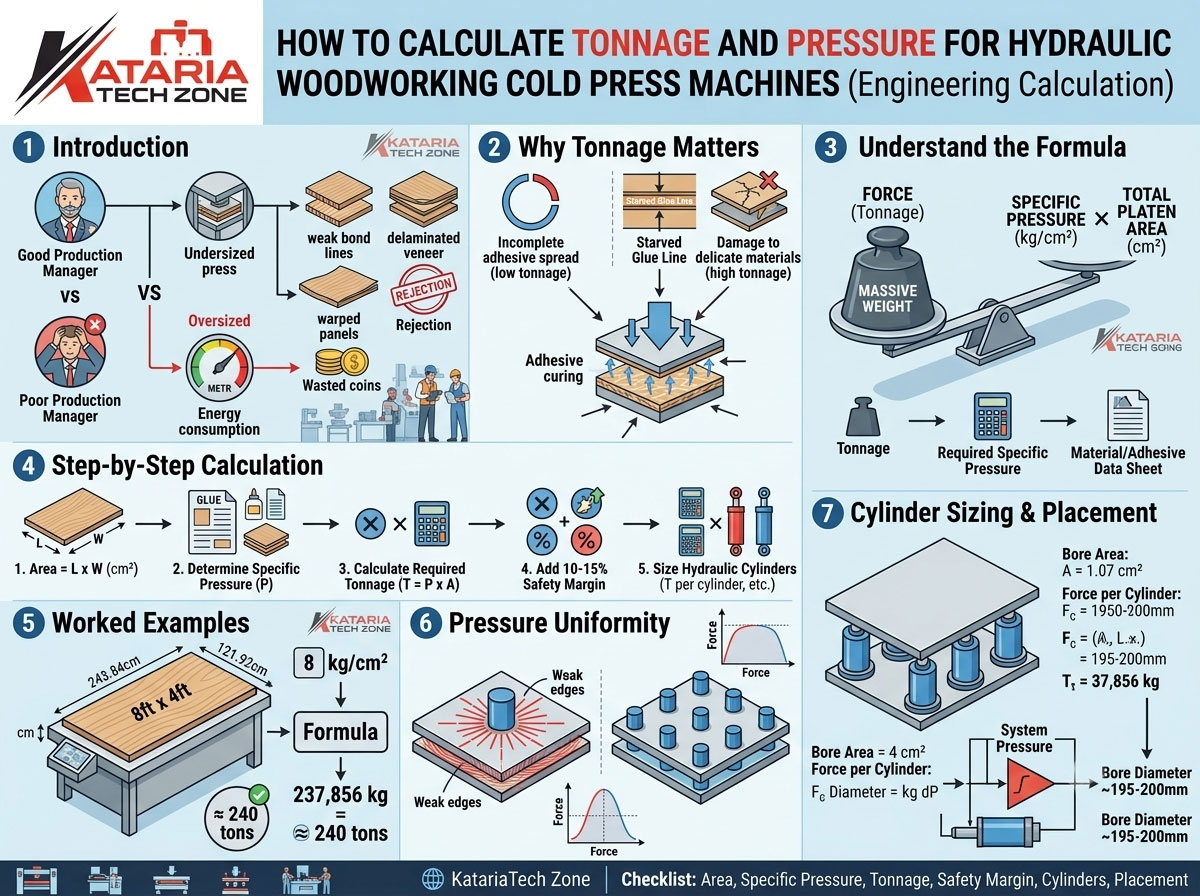
Ask any experienced production manager what happens when a cold press is undersized, and you’ll hear the same story: weak bond lines, delaminated veneer, warped panels, and rejected batches. Ask what happens when it’s oversized, you’ll hear a different one — wasted capital, higher energy consumption, and a machine that’s overkill for the job it does every day.
Both problems trace back to the same root cause: the tonnage and hydraulic pressure requirement wasn’t calculated correctly before the machine was specified. This isn’t a guess-and-check decision — it’s a straightforward engineering calculation once you understand the variables involved.
At Kataria Tech Zone, we manufacture Hydraulic Cold Press Machines for veneering, laminating, and panel bonding applications, and one of the most common questions we get from engineers and plant owners is: “How do I know what tonnage I actually need?” This article walks through the complete engineering calculation — from platen area to specific pressure requirements to hydraulic cylinder sizing — so you can specify (or evaluate) a cold press with confidence.
Why Tonnage Calculation Matters
A hydraulic cold press works by applying controlled, uniform force across a platen to bond layers of material — typically wood veneer, plywood, laminates, or composites — using adhesive that cures under pressure at ambient temperature. The tonnage rating of a press isn’t an arbitrary number; it’s a direct function of two things:
- The platen area — how much surface area needs pressure applied simultaneously.
- The specific pressure requirement — how much force per unit area the material and adhesive combination needs for proper bonding.
Get either of these wrong, and the consequences show up directly in product quality:
- Insufficient tonnage results in incomplete adhesive contact, weak bond strength, visible voids, and panels that delaminate under stress or humidity.
- Excessive tonnage can crush veneers, squeeze out too much adhesive (leading to starved glue lines), or damage delicate substrate materials, while also wasting capital on an oversized hydraulic system.
Getting this calculation right at the specification stage saves significant cost and rework later.
Step 1: Understand the Core Formula
The fundamental relationship between force, pressure, and area is:
Force (Tonnage) = Pressure × Area
Or, rearranged for sizing purposes:
Required Tonnage = Specific Pressure (kg/cm²) × Total Platen Area (cm²)
This is the starting point for every cold press sizing calculation. The two variables you need to determine are the platen area (which is largely dictated by your product size) and the specific pressure (which depends on your material and adhesive system).
Step 2: Calculate the Platen Area
Platen area is simply the working surface area of the press bed — the length multiplied by the width of the pressing surface, in consistent units (typically converted to square centimeters for this calculation).
Platen Area (cm²) = Length (cm) × Width (cm)
Worked Example
Suppose you’re specifying a cold press for standard plywood/veneer panels measuring 8 feet × 4 feet (a common panel size in Indian woodworking):
- Length = 8 ft = 243.84 cm
- Width = 4 ft = 121.92 cm
Platen Area = 243.84 × 121.92 = 29,732 cm² (approximately)
If your press has multiple daylight openings (multi-platen presses that press several panels simultaneously), you multiply this area by the number of openings, since hydraulic pressure must be maintained across all pressing surfaces simultaneously.
Step 3: Determine the Specific Pressure Requirement
This is the variable that requires the most engineering judgment, since it depends on the material being pressed, the adhesive system, and the desired bond quality. Specific pressure is typically expressed in kg/cm² or PSI, and industry practice provides general reference ranges based on application:
| Application | Typical Specific Pressure Range |
|---|---|
| Veneer-to-panel lamination (PVA/urea adhesives) | 6–10 kg/cm² |
| Plywood/blockboard core pressing | 8–12 kg/cm² |
| High-density composite/decorative laminate pressing | 10–15 kg/cm² |
| Door skin pressing | 6–9 kg/cm² |
| Rubber/plastic sheet consolidation | 10–20 kg/cm² |
Important: These are general reference ranges. Actual specific pressure requirements should always be confirmed against your adhesive manufacturer’s technical data sheet, since different resin systems (PVA, urea-formaldehyde, PU, epoxy) have different optimal curing pressures. Using too low a pressure for a given adhesive risks weak bonds; too high a pressure can starve the glue line of adhesive.
Step 4: Calculate Required Tonnage
Once you have both platen area and specific pressure, apply the core formula.
Worked Example (continued)
Using our 8 ft × 4 ft panel (29,732 cm² platen area) and assuming a specific pressure requirement of 8 kg/cm² for standard veneer lamination:
Required Force = 8 kg/cm² × 29,732 cm² = 237,856 kg
Convert to metric tons (1 metric ton = 1,000 kg):
Required Tonnage = 237,856 kg ÷ 1,000 = 237.86 tons ≈ 240 tons
This tells you that for this panel size and pressure requirement, you’d need a cold press rated at approximately 240 tons of total pressing force. In practice, manufacturers build in a safety margin (typically 10–15%) above the calculated requirement to account for pressure variation, adhesive inconsistency, and future flexibility, so a 260–275 ton press would be a sensible specification for this application.
Step 5: Size the Hydraulic Cylinders
Once total tonnage is known, the next engineering step is determining the hydraulic cylinder specifications needed to generate that force. This depends on your hydraulic system’s operating pressure (typically set by the pump and valve system).
Cylinder Force = Hydraulic System Pressure (kg/cm²) × Cylinder Bore Area (cm²)
To find the required cylinder bore area:
Required Bore Area (cm²) = Total Force Needed (kg) ÷ Hydraulic System Pressure (kg/cm²)
Worked Example
Assuming your hydraulic power pack operates at a system pressure of 200 kg/cm² (a common operating pressure for industrial hydraulic presses), and you need to generate 237,856 kg of total force using, say, 4 cylinders working together:
Force per cylinder = 237,856 kg ÷ 4 = 59,464 kg
Required Bore Area per cylinder = 59,464 kg ÷ 200 kg/cm² = 297.3 cm²
From bore area, you can calculate the required cylinder diameter using:
Bore Area = π × (Diameter/2)²
Rearranged: Diameter = √(4 × Bore Area ÷ π)
Diameter = √(4 × 297.3 ÷ 3.1416) = √378.6 = 19.5 cm (≈195 mm)
This tells the hydraulic system designer that each cylinder needs a bore diameter of approximately 195–200 mm to deliver the required force at the given system pressure — critical information for selecting or fabricating the correct hydraulic cylinders.
Step 6: Account for Pressure Uniformity Across the Platen
A calculation that only looks at total tonnage can miss an important practical issue: pressure uniformity. A single central cylinder generating the correct total tonnage will not distribute that force evenly across a large platen — the center will be over-pressured while the edges are under-pressured, leading to inconsistent bonding.
This is why properly engineered cold presses use multiple strategically placed cylinders rather than one large central cylinder, ensuring even pressure distribution across the entire platen surface. When calculating cylinder placement:
- Divide the platen into zones of roughly equal area.
- Position one cylinder per zone, ensuring the centroid of each zone aligns with its cylinder’s line of force.
- Verify that platen thickness and material rigidity are sufficient to prevent deflection between cylinder points — a platen that flexes between pressure points will still produce uneven bonding even with correctly sized cylinders.
Kataria Tech Zone’s Hydraulic Cold Press Machines are engineered with multiple pressing cylinders and precision-machined platens specifically to solve this uniformity challenge, ensuring consistent pressure across the full pressing surface rather than relying on a single-point force calculation alone.
Step 7: Factor in Dwell Time and Cycle Requirements
While not part of the tonnage calculation itself, dwell time (the duration pressure is held) is a related engineering consideration that affects overall press selection. Higher specific pressures can sometimes allow shorter dwell times for the same bond quality, and vice versa — so tonnage and cycle time decisions should be made together, not in isolation, especially when calculating overall production throughput requirements.
Common Mistakes in Tonnage Calculation
Even experienced buyers make avoidable errors when sizing a cold press:
- Using platen area instead of actual product area when panels don’t fill the entire platen, leading to oversized (and overpriced) machine specifications.
- Ignoring adhesive manufacturer specifications and relying on generic pressure assumptions that don’t match the actual resin system in use.
- Not accounting for multi-opening presses correctly, forgetting that total tonnage requirements multiply with each additional pressing daylight.
- Underestimating safety margin, resulting in a press that’s marginal for the application and struggles with any variation in material thickness or moisture content.
- Overlooking cylinder placement and pressure uniformity, focusing only on total tonnage while ignoring how that force is distributed across the platen.
Quick Reference: Tonnage Calculation Summary
- Platen Area (cm²) = Length × Width
- Specific Pressure (kg/cm²) = Based on material/adhesive requirement (confirm with adhesive datasheet)
- Required Tonnage = (Specific Pressure × Platen Area) ÷ 1,000, converted to metric tons
- Add safety margin of 10–15% to the calculated tonnage
- Cylinder Bore Area = Force per Cylinder ÷ Hydraulic System Pressure
- Cylinder Diameter = √(4 × Bore Area ÷ π)
How Kataria Tech Zone Approaches Cold Press Sizing
At Kataria Tech Zone, every Hydraulic Cold Press Machine we manufacture is engineered around this exact calculation process — platen area, specific pressure requirement, cylinder sizing, and pressure uniformity — rather than offered as a generic, one-size-fits-all product. Our engineering team works directly with customers to understand panel sizes, adhesive systems, and production volumes before recommending the right tonnage and configuration.
If you’re specifying a new cold press or evaluating whether your current machine is correctly sized for your application, our team can walk through this calculation with your actual production parameters.
Explore our full machine range and related resources:
- 🔧 Hydraulic Cold Press Machine — our featured cold press model
- 📂 Woodworking Cold Press Category — full specifications and options
- 📂 Vacuum Membrane Press — for contoured and 3D lamination applications
- 📂 Edge Banding Machine — for panel edge finishing
- 📂 Panel Saw — for precision panel sizing before pressing
- 📝 Automatic Edge Banding Machine Setup: How to Eliminate Glue Line Gaps and Rough Cuts — related troubleshooting guide
- 📝 Maximizing Workshop ROI: How to Choose Between a Vertical and Horizontal Panel Saw — related buying guide
- 📝 How to Plan the Workshop Layout for a Modern Modular Furniture Factory — related workshop planning guide
- 📚 Wood Working Blog Category — more woodworking machinery guides
🌐 Website: katariatechzone.com
Frequently Asked Questions
Q1. What is the difference between tonnage and specific pressure in a cold press? Tonnage refers to the total force the press can generate across its entire platen, while specific pressure refers to force per unit area (kg/cm²). Two presses with the same tonnage but different platen sizes will apply very different specific pressures to the material being pressed — which is why platen area must always be part of the calculation, not tonnage alone.
Q2. How much safety margin should I add to my calculated tonnage requirement? A margin of 10–15% above the calculated requirement is standard industry practice, accounting for variations in material thickness, adhesive spread rate, moisture content, and future production flexibility.
Q3. Does a higher tonnage press always produce better bonding results? No. Bonding quality depends on matching specific pressure to the material and adhesive system — not on maximizing tonnage. Excessive pressure can actually damage veneers or starve glue lines of adhesive, reducing bond quality rather than improving it.
Q4. Why do larger cold presses use multiple hydraulic cylinders instead of one large cylinder? Multiple cylinders, correctly positioned, ensure even pressure distribution across the full platen area. A single central cylinder generating the same total tonnage would over-press the center and under-press the edges, resulting in inconsistent bond quality across the panel.